
 One of the most common things we hear from business owners is “I don’t know if my website is working.” What they usually mean is they have no idea whether their website is actually generating enquiries. That’s an important distinction, because it points to a misunderstanding that costs a lot of NZ businesses money every year. A website isn’t just an online brochure. It’s a marketing tool, and like any marketing tool, it needs the right things working alongside it to deliver results. Getting clear on what those things are, and where your budget is best spent, is what this article is about.
The landscape has changed
For most of the last 15 years, the standard advice for small business digital marketing was fairly predictable: get a website built, do some SEO to build organic traffic, maybe run some Google Ads if you needed faster results. That framework still has merit, but the environment around it has shifted considerably in the last couple of years.
Google’s search results page looks very different in 2026 than it did even two years ago. AI-generated summaries now appear at the top of results for a wide range of searches, answering questions before a user ever clicks through to a website. Organic click-through rates have dropped as a result, particularly for informational searches. Google Ads costs have continued to climb in most industries. And the trust signals that influence whether someone picks up the phone or fills in a form have expanded well beyond just having a tidy website.
None of this means digital marketing doesn’t work. It means the mix matters more than it used to, and getting any one part of it wrong is more expensive than it used to be.
SEO is still worth investing in, but the goal has shifted
Search engine optimisation remains one of the most cost-effective long-term investments a small NZ business can make, but what you’re trying to achieve with it has changed. Ranking well is no longer purely about generating clicks. In a world where AI Overviews appear above organic results for many searches, being cited as a source within those summaries delivers meaningful brand visibility even when users don’t click through to your site. That requires well-structured, genuinely useful content on a technically sound website, not thin pages assembled around keywords.
Local SEO is particularly resilient to these changes. Searches where someone is looking for a specific service in a specific place, a builder in Whangarei, a dentist in Kerikeri, a plumber in Kaitaia, still drive real clicks and real enquiries. Google is much less likely to fully answer those searches on the results page itself, because the user still needs to find and contact an actual business. If your customers are local, investing in the fundamentals of local SEO is still one of the best uses of your marketing budget.
The honest caveat is that SEO takes time. Most businesses need to allow at least three to six months before they see meaningful movement in organic rankings, and that’s assuming the foundational work is done properly from the start. If you need leads in the next thirty days, SEO alone won’t get you there. That’s where Google Ads earns its place.
Google Ads: powerful, but easy to get wrong
Google Ads can put your business in front of people who are actively searching for what you offer, and it can do it quickly. For businesses that need a consistent flow of enquiries and have a realistic budget to support it, it remains one of the most direct ways to generate leads online. The problem is that a badly run campaign doesn’t just underperform. It burns through your budget while producing nothing useful, and it can do that for months before anyone notices.
The mistakes we see most often aren’t complicated. Location settings are one of the most common. Google’s default setting targets people who have shown an interest in your area, not just people who actually live or work there. This setting has its place but for a local business in Northland, that distinction matters enormously. A campaign left on default settings can end up serving ads to people in Auckland or Wellington who once searched for something Northland-related, while the local customers you actually want to reach aren’t being targeted properly.
Negative keywords are another area where campaigns quietly bleed money. Without regular attention, broad match keywords attract searches that have nothing to do with your business. A landscaping company might find their budget going toward searches for landscaping software, landscaping courses, or DIY landscaping videos. None of those searchers want to hire anyone. Adding and maintaining a solid negative keyword list is one of the highest-value things an experienced manager does, and it’s one of the first things that gets neglected in a set-and-forget campaign.
Campaign structure causes problems too. Bundling all your keywords into a single ad group means your ads can’t be tailored to what someone is actually searching for, which reduces relevance, increases cost per click, and sends people to pages that don’t match their intent. Someone searching for “commercial painting Whangarei” should land on a page about commercial painting, not your homepage. Poor structure makes that kind of matching impossible to do well.
Then there’s tracking. Google’s standard conversion tracking tends to measure website visits and page views, which look reassuring in reports but don’t tell you whether anyone actually made a purchase, filled in a form or picked up the phone. Without meaningful conversion tracking in place, you’re making budget decisions based on data that doesn’t reflect real business outcomes. You genuinely don’t know if the campaign is working.
Review management is no longer optional
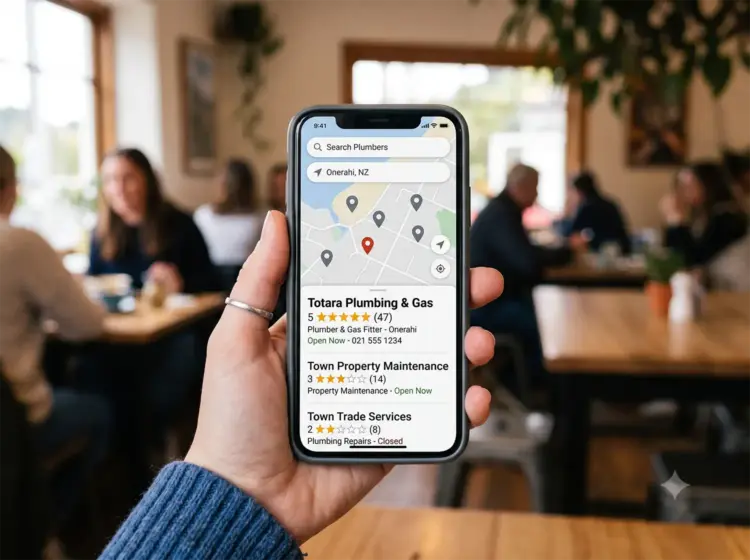 This is the area most small NZ businesses are underinvesting in right now, and it’s becoming increasingly costly to ignore. Your Google Business Profile and the reviews on it are often the first thing a potential customer sees, and in many cases they’ve already formed a view about your business before they ever reach your website.
Reviews also directly influence your local search rankings. Google weighs the volume and recency of reviews when deciding which businesses to show in local results. A business with thirty reviews from three years ago will consistently lose ground to a competitor who is actively generating fresh ones. The recency of reviews matters almost as much as the overall star rating.
The difficulty most businesses face is that collecting reviews consistently requires a system. Happy customers rarely think to leave one unprompted, and asking in person can feel awkward or easy to forget. An automated process to get more reviews that reaches out to customers after a job or visit, guides satisfied ones toward leaving a Google review, and surfaces any issues privately before they become public complaints, makes a significant difference to how quickly a review profile builds. It also means you hear about problems early enough to fix them, rather than discovering a one-star review weeks after the fact.
What about social media?
Social media is a powerful asset for building brand awareness, showcasing your team, and creating trust with your local community. For many NZ service and trade businesses, it works well as a digital handshake that validates your reputation. Because social media tends to be very visual, many service providers find that social media shines brightest when supporting your brand rather than acting as your sole source of new enquiries.
If you are looking for the most direct, budget-friendly way to generate immediate leads, prioritising your Google Business Profile is a proven game-changer. Gathering a steady flow of recent customer reviews on Google often delivers a much faster, more measurable return on investment than regular social media posting. Maintaining a social media presence is still highly valuable for staying connected, but aligning your time and budget with where local clients actively search for services will help you maximise your growth.
Putting it together
The businesses we see getting consistent results from their digital marketing aren’t doing anything exotic. They have a professionally built website that gives people a clear reason to get in touch. They’re investing in local SEO so the right people can find them. They’re running Google Ads with proper structure, targeting, and tracking rather than leaving it on autopilot. And they’re actively managing their reviews so their online reputation reflects the quality of work they’re actually doing.
What ties all of that together is having someone who understands how each channel affects the others, and who’s paying attention to what the numbers are actually telling you rather than just keeping the lights on.
⚡ TL;DR: Where to Put Your Digital Marketing Budget in 2026
The channels that drive results for NZ small businesses haven’t changed dramatically, but how well you need to execute them has.
- Your website is a marketing tool, not a brochure. If you don’t know whether it’s generating enquiries, that’s the first problem to solve.
- Local SEO is still resilient. AI Overviews are eating into informational search traffic, but local service searches still drive real clicks and real enquiries.
- Google Ads work, but only when managed properly. Wrong location settings, poor negative keyword management, weak campaign structure, and inadequate tracking are all common and all costly.
- Reviews are a ranking signal, not just a trust signal. Volume and recency both matter, and building them consistently requires a system rather than good intentions.
- Social media builds trust, Google Business Profile drives leads. Use social to showcase your team and build your brand, but prioritise your Google Business Profile and reviews for direct enquiries.
The Bottom Line: The mix of SEO, Google Ads, and review management working together will outperform any single channel on its own. Getting the basics right across all three is where the return is.
How Energise Web Can Help
We’ve been helping NZ small businesses get results from digital marketing since 1999, and we look after all of the channels covered in this article. Whether you want to know if your Google Ads are actually working, get your local SEO foundations sorted, or put a proper review management process in place, we’re happy to have a straight conversation about what’s likely to make the most difference for your business. Get in touch with us at energise.co.nz/quote/ and let’s work it out.