
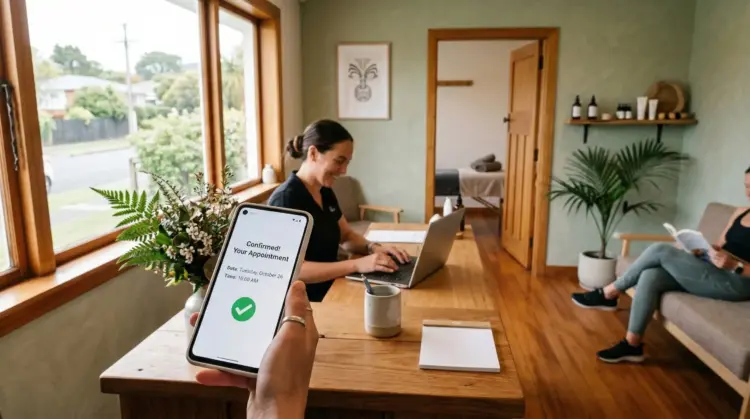
 If you run a service business in New Zealand, whether that is a hair salon, a physio clinic, a tutoring service, or a consultancy, chances are you rely heavily on the phone. Customers call, you book them in, and the process works well enough. But customer habits are shifting, and more people now expect to be able to book services online, on their own terms, at a time that suits them. If your website does not offer that option, you may be losing bookings without ever realising it.
What a Missed Booking Actually Costs You
Most business owners accept that they miss the occasional booking, and mentally file it under things that cannot be helped. But it is worth pausing on what that actually means in dollar terms. Think about your average appointment value, whether that is a haircut, a physio session, a tutoring hour, or a consulting call. Now think about how many times a week someone might visit your website outside business hours, decide they want to book, find no way to do it, and move on. Even if that only happens twice a week, and for many service businesses it happens considerably more often than that, you are looking at a meaningful gap in revenue over the course of a month. The appointments you never knew you lost are the ones most worth thinking about, because there is no missed call notification and no voicemail to follow up on. The customer simply disappears.
The Phone Is Not Dead, But It Is No Longer Enough
Phone bookings are not going away. Some customers will always prefer a conversation, especially for more complex or personal services, and there is real value in that. Nobody is suggesting you pull your phone number off the website. What is worth thinking about, though, is what happens when someone visits your website at 9pm on a Tuesday, decides they want to book an appointment, and finds no way to do it except call a number that will not be answered until morning. Many of them will not call back. They will move on and book with someone else who made it easy.
That is the gap online booking fills. It is not about replacing the phone or making your business feel impersonal. It is about being available when your customers are ready to commit, which is not always during business hours. A business that offers both options removes the friction entirely, and removing friction is usually what separates the booking that happens from the one that does not.
It helps to think about this from the customer’s side. Someone finishes work at 6pm, remembers they have been meaning to book a massage, picks up their phone, finds your website, likes what they see, and then hits a wall because there is no way to book without calling. That moment of intent is gone. They might genuinely intend to call tomorrow, but most will not get around to it. The business that had an easy booking option on their website got that appointment instead, not because they offered a better service, but because they made it easier to say yes.
What the Research Actually Says
You may have seen statistics floating around the internet claiming that “70% of customers prefer to book online.” These figures often come from the travel and hospitality sector, where online booking has been standard for over a decade, and they do not necessarily reflect the behaviour of someone looking to book a haircut or a consultation in your area. It is worth being realistic about what the data actually shows for service businesses like yours.
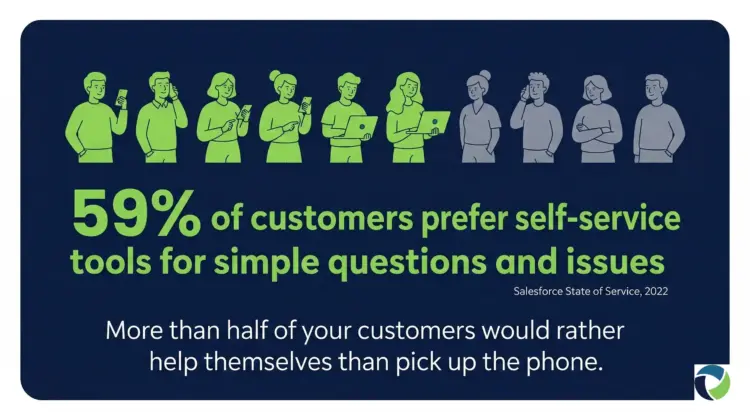 What we can say with reasonable confidence is that self-service expectations are growing across all industries. Salesforce’s 2022 State of Service report found that 59% of customers prefer self-service tools when they have a simple question or issue. That is a meaningful figure, because most routine service bookings fall squarely into that category. People increasingly want to be able to take action themselves without having to pick up the phone and wait for someone to get back to them.
Younger customers are driving a lot of this change. Millennials and Gen Z now make up a significant portion of the spending population, and research from Zendesk has consistently shown that these groups favour digital self-service and non-phone channels for routine interactions. If your services appeal to anyone under 40, that preference is likely already showing up in how they engage with your website.
One pattern that holds across sectors is that a meaningful proportion of online bookings happen outside standard business hours, typically in the evenings and on weekends. If your booking process requires a phone call during office hours, you are simply not reachable at the moments when people are sitting down, looking at their phones, and ready to act. New Zealand’s internet penetration sits at around 95%, and 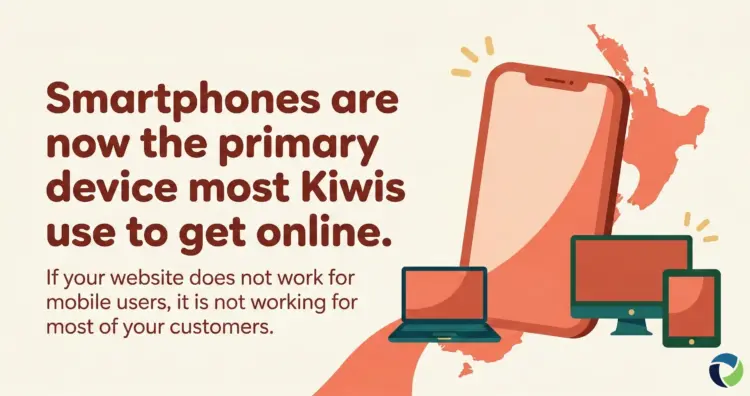 smartphones are now the primary device most Kiwis use to get online. Your customers are already on their phones. The question is whether your website gives them something to do when they get there.
Why Small Businesses Have Not Added Online Booking Yet
If online booking makes sense for service businesses, why have so many not added it? In working with small businesses across NZ for over 25 years, there are a few objections that come up regularly, and most of them are understandable but worth examining.
The most common one is the assumption that customers prefer to call. That may be true for a portion of them, which is exactly why keeping the phone option available matters. But it is worth asking whether you have actually tested the alternative, or whether you are making an assumption based on the customers you hear from rather than the ones who quietly went elsewhere. The second concern is usually that online booking seems complicated or expensive to set up. In practice, there are purpose-built booking tools that can be embedded into an existing website without a full rebuild, and many of them have low-cost or free tiers suitable for small businesses. The real question is whether the cost of the tool is outweighed by the bookings you are currently missing.
Some business owners also worry about losing control of their schedule. This is a reasonable concern, but modern booking systems can be configured with minimum notice periods, daily booking limits, confirmation and reminder emails, and buffer time between appointments. You set the rules, and the system works within them. In practice, most business owners find they have more visibility over their upcoming bookings after switching to an online system, not less, because everything is in one place and confirmed automatically.
What Good Online Booking Looks Like
Not all booking systems are created equal, and how the feature is implemented on your website matters as much as whether you have it at all. A well-integrated booking feature should be easy to find and use on a mobile device, show your real-time availability, send automatic confirmation and reminder messages, and allow customers to cancel or reschedule without having to call. It should also collect the information you need upfront, so you are not following up with multiple emails just to confirm the basics.
One of the most underappreciated benefits of a proper booking system is what it does to your no-show rate. Automated reminders sent the day before an appointment, or a few hours ahead, give customers a nudge at the right moment and make it easy to cancel or reschedule if something has come up. For salons, clinics, and tutors especially, no-shows are a real cost, and a booking system that reduces them even slightly pays for itself quickly. A phone-based booking process simply cannot replicate this without someone on your team manually sending texts or making reminder calls.
Equally important is how the booking experience feels to the person using it. A widget that looks bolted on, or that redirects customers to a generic third-party page with no connection to your brand, is less reassuring than one that feels like a natural part of your website. This is one reason why having a booking system properly integrated by a web developer makes a real difference to whether people actually use it.
Online Booking Is Not Right for Every Business
It is worth being honest here: fully automated online booking does not suit every type of service business. If your work requires a site visit before you can quote, involves significant variation in scope, or depends on a detailed intake conversation before anything can be confirmed, then handing customers a live calendar to book into is probably not the right first step. Trades, project-based consultants, and businesses where every job is genuinely different fall into this category. For those businesses, the goal is not to automate the booking itself but to make the initial enquiry as easy as possible and reduce the time it takes to get from first contact to confirmed appointment.
A well-designed enquiry form can do a lot of that work. It can ask the right qualifying questions upfront, route enquiries to the right person, and give customers a way to reach out at any time without needing to call. For some businesses, this kind of form is actually a better fit than a full calendar booking system, because it keeps a human in the loop while still reducing the back-and-forth that eats into your day. We have written in more detail about how to get the most out of this in our article on smart website forms, which covers how forms can be set up to reduce admin and start conversations in a much more organised way.
Offering Both Options Is the Point
The research does not say every customer wants to book online. What it shows is that a growing number of customers expect that option to be available, and that its absence can be a reason to choose a competitor instead. The customers who prefer calling will still call. The ones who would rather not make a phone call, and there are more of them every year, will have a reason to choose you over the business that only offers a number to ring.
There is also a trust dimension to this that is easy to overlook. A well-presented booking system signals to first-time visitors that your business is organised, established, and respectful of their time. For someone who has never dealt with you before, being able to see your availability, choose a time, and receive an instant confirmation is a more reassuring experience than being told to call during office hours and wait to hear back. That first impression matters, particularly when someone is choosing between two businesses they know nothing about yet.
The businesses that handle this well do not make it a choice between one option or the other. They put both clearly on their website: a booking option for people who are ready to commit, and a phone number and contact form for those who want to talk first. That combination tells customers that you are easy to work with, and in a competitive local market, that impression matters more than most business owners realise.
⚡ TL;DR: Are You Losing Bookings While You Sleep?
In a world of instant gratification, the distance between a customer wanting your service and actually booking it should be as short as possible. If they have to wait until Monday morning to call you, they might not wait at all.
- The Problem: Relying only on phone calls creates “booking friction.” If a customer can’t book when they’re ready (often at 9pm), they’ll likely find a competitor who makes it easier.
- The Shift: NZ customers (especially those under 40) now expect 24/7 self-service. Online booking captures “after-hours” revenue you didn’t even know you were missing.
- The Benefits: Automated systems reduce manual admin and slash “no-show” rates through automated reminders.
- The Hybrid Approach: You don’t have to choose. Keep the phone for complex queries, but use a digital portal for everything else.
The Bottom Line: Don’t let a “closed” sign stop a customer who is ready to say “yes” right now.
Ready to Add Online Booking to Your Website?
If your website is still relying on a phone number and a basic contact form to capture bookings, it may be time to look at what else is possible. We can help you work out whether online booking is the right fit for your business, which tools will suit your workflow, and how to set it up so it actually gets used.